
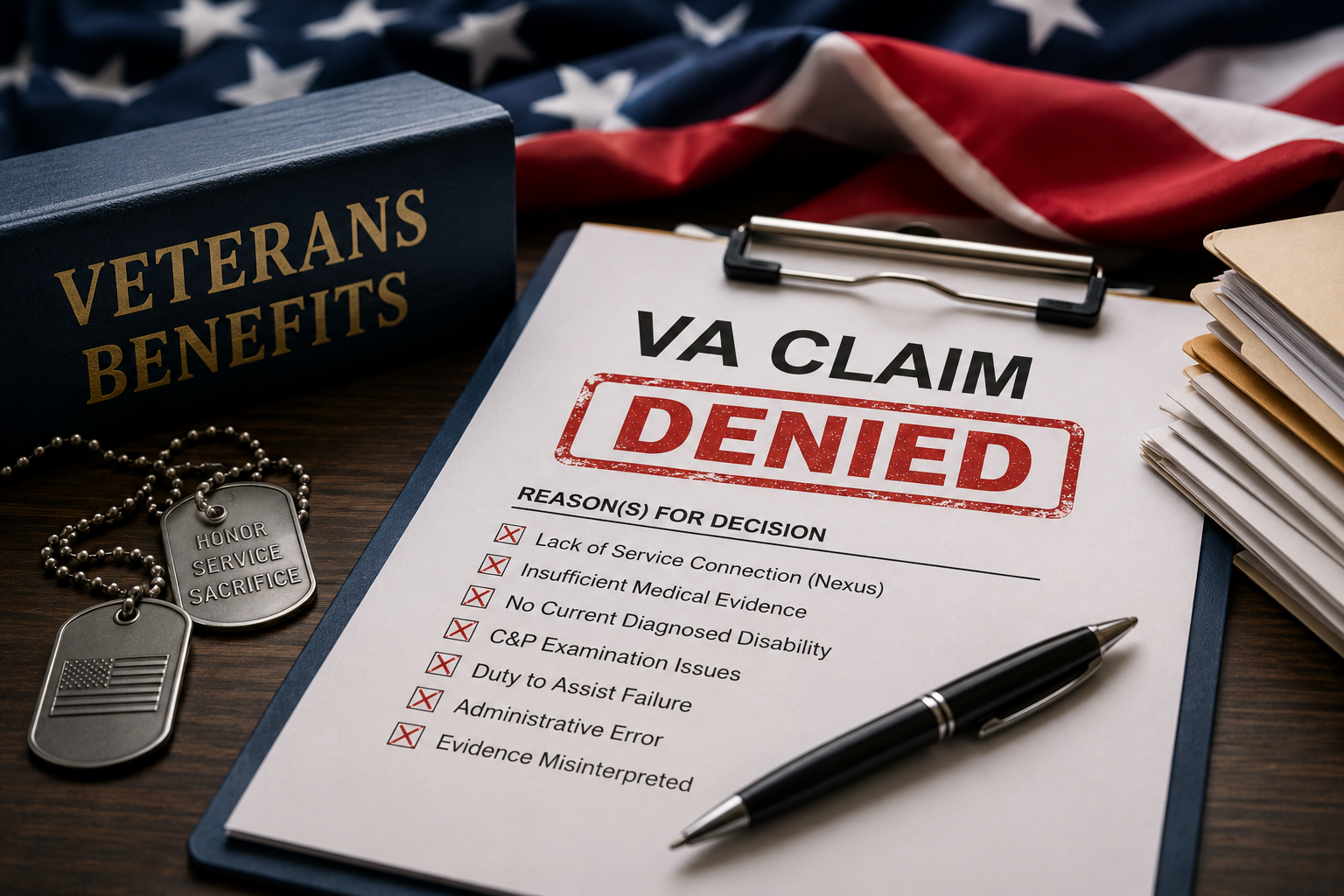
Receiving a denial letter from the Department of Veterans Affairs (VA) can be frustrating, confusing, and discouraging. Many veterans spend months gathering paperwork, attending medical appointments, and completing applications only to learn that their claim for disability benefits has been denied.
If you've ever wondered, "Why did the VA deny my claim?" you're not alone.
Every year, thousands of veterans receive claim denials despite having legitimate service-connected disabilities. In many cases, the denial is not because the veteran is undeserving of benefits. Instead, claims are often denied due to missing evidence, lack of a medical nexus, procedural mistakes, inadequate examinations, or other issues that can potentially be corrected.
Understanding the most common VA denial reasons can help veterans avoid mistakes, strengthen future claims, and pursue successful appeals when necessary.
This guide explains the most common reasons the VA denies disability claims, provides examples of how these issues arise, and outlines practical steps veterans can take to overcome them.
The VA processes hundreds of thousands of disability claims every year. While many claims are approved, a significant number are denied due to strict evidentiary requirements and complex regulations.
Many veterans assume that proving they served in the military and have a medical condition should be enough to receive benefits. Unfortunately, the VA requires specific evidence to establish entitlement to disability compensation.
To approve a claim, the VA generally looks for three essential elements:
When one or more of these elements is missing or inadequately documented, a denial may occur.
In addition, administrative mistakes, missing records, and inadequate examinations can contribute to unfavorable decisions.
Understanding these common issues is often the first step toward overcoming them.
One of the most common VA denial reasons is the lack of a service connection nexus.
A nexus is the medical link between a veteran's current disability and their military service. Even when a veteran clearly has a diagnosed condition, the VA may deny the claim if it is not convinced that military service caused or contributed to that condition.
A veteran develops chronic migraines years after leaving the military. While the veteran has a valid diagnosis, the claim may be denied if there is insufficient evidence connecting the condition to military service.
The VA often denies claims when:
Veterans can strengthen their claims by:
A strong nexus opinion frequently becomes one of the most important pieces of evidence in a successful claim or appeal.
Another common reason the VA denies claims is insufficient medical evidence.
The VA relies heavily on medical documentation when evaluating disability claims. Even legitimate conditions can be denied if supporting records are incomplete or unavailable.
Veterans may face denial because:
A veteran experiences severe back pain that began during service but rarely sought treatment after discharge. Years later, when filing a claim, there is little medical documentation supporting the condition.
Although the veteran's pain is real, the lack of evidence may make approval difficult.
Veterans can improve their claims by:
The stronger the documentation, the easier it becomes to demonstrate entitlement to benefits.
The VA generally requires evidence of a current disability before awarding compensation.
Many veterans experience symptoms that interfere with daily life but have not yet received a formal diagnosis.
Without a current diagnosis, the VA may conclude that a compensable disability does not exist.
A veteran suffers chronic knee pain but has never undergone imaging studies or received a formal diagnosis from a medical provider.
Even if the symptoms are severe, the claim may face denial.
Veterans should consider:
Current medical evidence can significantly strengthen a claim.
The Compensation and Pension examination plays a major role in many disability claims.
Unfortunately, C&P exams sometimes contribute to claim denials.
Veterans frequently report concerns such as:
A veteran attends a C&P examination for PTSD. The examiner spends only a short time discussing symptoms and later issues a report that fails to accurately reflect the veteran's condition.
The resulting opinion may negatively impact the claim.
Veterans may be able to:
An unfavorable C&P examination does not necessarily mean a claim cannot succeed.
The VA has a legal obligation known as the Duty to Assist.
This obligation generally requires the VA to help veterans obtain evidence necessary to support their claims.
However, mistakes can happen.
These may include:
When these errors occur, veterans may receive denials that could have been avoided.
Veterans should carefully review denial decisions and determine whether important evidence was overlooked.
Potential solutions include:
Identifying Duty to Assist failures can sometimes provide powerful grounds for challenging a denial.
Not every denial occurs because of weak evidence.
Sometimes simple procedural issues create significant problems.
These may include:
A veteran submits medical records supporting a disability claim. Due to an administrative oversight, the records are never reviewed before a decision is issued.
The resulting denial may not accurately reflect the available evidence.
Veterans should:
Organization can help prevent avoidable setbacks.
In some situations, the necessary evidence exists but is interpreted incorrectly.
Veterans may encounter situations where:
These situations can result in denials even when substantial evidence supports the claim.
Possible strategies include:
A thorough review of the claim file often reveals weaknesses in the VA's analysis.
A denial is not necessarily the end of the process.
Veterans have multiple potential options for seeking review of unfavorable decisions.
The denial letter often explains:
Understanding the specific denial reason is critical.
The next step may involve obtaining:
Depending on the circumstances, veterans may pursue:
Choosing the right path often depends on the facts of the individual case.
Many veterans assume that once the VA denies a claim, there is little they can do.
In reality, legal representation often helps identify problems that contributed to the denial.
Attorneys experienced in VA disability law may assist by:
Many denied claims are ultimately approved after additional evidence and legal advocacy are provided.
Receiving a VA disability claim denial can feel overwhelming, but it does not necessarily mean your claim lacks merit.
Many denials result from issues such as insufficient evidence, lack of a nexus, inadequate C&P examinations, administrative errors, or failures in the VA's duty to assist. Understanding these common VA denial reasons allows veterans to take proactive steps to strengthen their claims and pursue available appeal options.
If you're asking, "Why did the VA deny my claim?" the answer may lie in missing documentation, procedural mistakes, or evidence that was never fully developed.
By identifying the reason for the denial and taking corrective action, veterans can often improve their chances of securing the benefits they earned through their service.
If your VA disability claim has been denied, Veterans Affairs Law can help evaluate your case, identify the reasons behind the denial, gather supporting evidence, obtain nexus opinions, and determine the best strategy for moving forward.
Contact Veterans Affairs Law today for a free case evaluation and learn how experienced legal representation may help you pursue the benefits you deserve.
Please call us at (941) 552-6677 or fill out the form below and someone from our team will be in touch shortly.


© 2026 Veterans Affairs Law | All Rights Reserved | Privacy Policy | LLM Info | Website by DigiSphere Marketing
